Curated by Diego Sileo and Beatrice Benedetti
The exhibition is promoted by the Municipality of Milan - Culture Directorate and produced by PAC and Silvana Editoriale. The project has been established thanks to Tod’s, with the support of Vulcano; technical partner Coop Lombardia; thanks to Reti S.p.A.
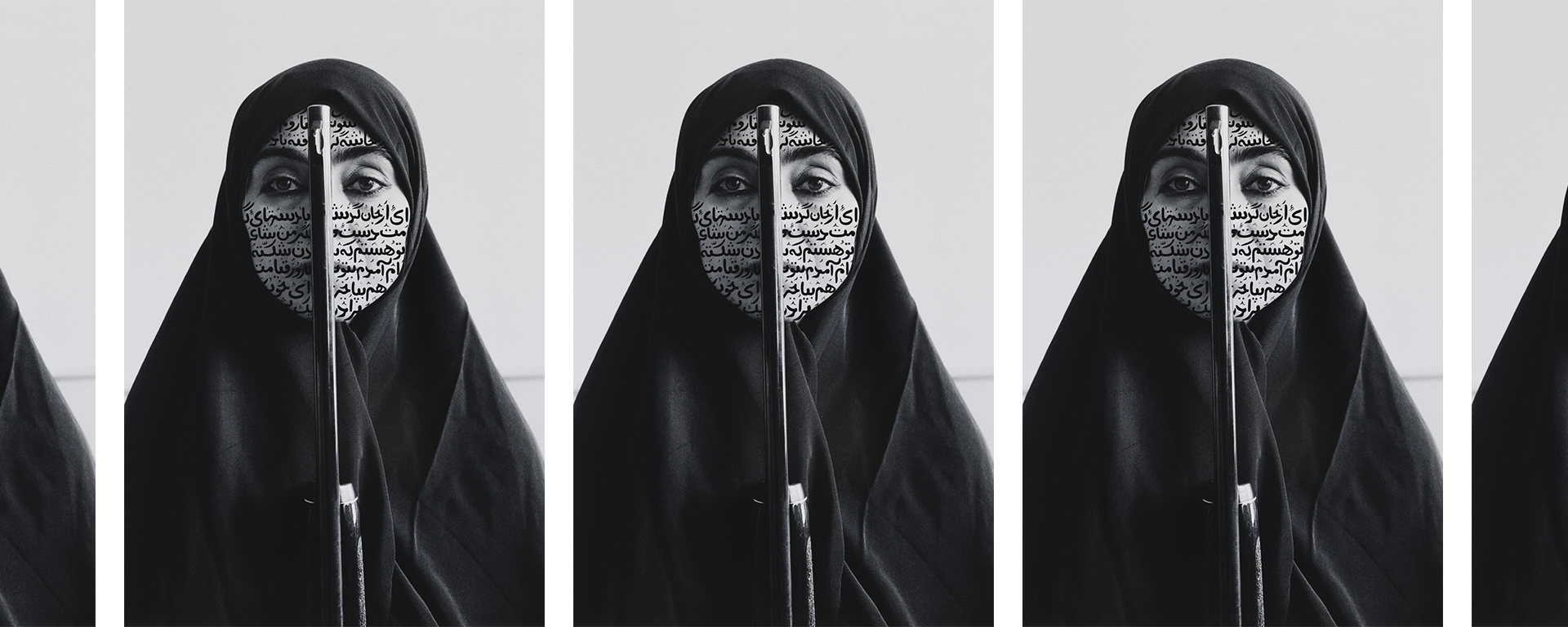
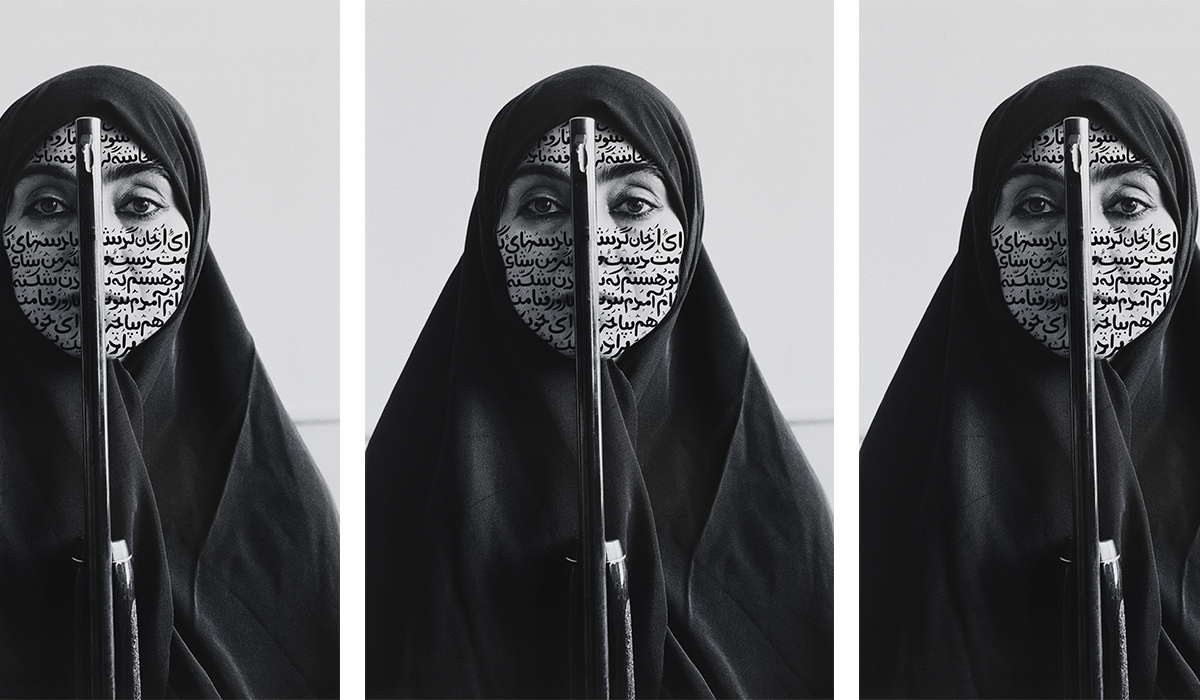
Shirin Neshat, Rebellious Silence, 1994
gelatin silver print and ink
© Shirin Neshat
Courtesy of the artist and Gladstone Gallery


Shirin Neshat is an Iranian born artist based in New York. In 1974, she moved to the United States to study art, choosing to remain there in self-imposed exile after the Iranian Revolution. In 1979, when she was in Los Angeles, the Islamic Revolution ended the monarchy of the shah, bringing Ruhollah Khomeini and the ayatollahs to power. Iran was turned into a theocracy, the laws of which were based on the Qur’an, and all western influence was eradicated. It was not until after the death of Khomeini in 1989 that Neshat was able to return to her homeland. Her first trip home was in 1990, and she was deeply shaken by the changes imposed by the regime. As a result, through her work Neshat began to reflect on the profound transformation that occurred in her country after the 1979 Islamic Revolution.
This reflection also led her to grapple with the subject of the role of women, linking Islam and feminism, analysing the dynamics underpinning social structures in the relationships between the genders and questioning her own position as an exile, poised between two worlds in which she has often felt simultaneously, and in different ways, part of and marginalised.
This exhibition, not organised chronologically but according to the artist’s preferred media and languages (photography and video), gets to the heart of this investigation. In some cases, the political aspect of the works is more explicit, in others the questioning of rooted cultural convictions is addressed as much to the West as to the East, thereby raising a series of questions.
Fervor (2000) is the third and final film of a trilogy that also includes Turbulent and Rapture (on view in the next room). The work explores the relationship between the two sexes within Iran’s Islamic social structure. The main characters of this film are a man and a woman who encounter each other by chance in an isolated, open place. The fortuitous meeting of their eyes ignites instant passion, but they both immediately continue on their separate paths. Later, the man and woman meet again, but in a different context: in the middle of a crowd at a public gathering, which is unclear, if a political or religious ceremony, where men and women are separated by a long black curtain. Once they have taken their places in their respective areas, they hear a man standing on a stage telling the Koranic parable of Zolikha and Youssef, in which the former, carried away by passion for the latter, tries to seduce him. The speaker warns about the sin inherent to desire, emphasising the importance of resisting temptation. The clear division between the two groups is highlighted by the chromatic contrast of the men in white shirts and the veiled women in black. The meeting point between the two seems to be the man, dressed in grey, on the stage in the middle. At a certain point, while listening to him, the two main characters unwittingly and simultaneously turn towards each other for an instant, without being able to see each other. As the talk continues, becoming progressively heated, the two become increasingly disturbed until the woman finally stands up and leaves. The projection on two different channels, one next to the other like the two main characters, reinforces the feeling of attraction without any possibility of contact. The two bodies are kept in a separate and parallel space and narrative, without ever meeting up close. As observed by the artist herself, the film shows how sexual taboos were interiorised by men and women in equal measure.
Turbulent (1998) and Rapture (1999) are the first two films in the trilogy. Turbulent marks the moment when the artist began to become interested in the moving image, after her focus on photography. In these two films as well, the dual contrast of the images reflects the relationship between the two sexes in Iran’s Islamic society. They also feature the double channel, white (the clothing worn by the men) and black (the clothing of the veiled women). Turbulent is premised on the fact that in Iran, after the 1979 Revolution, women were forbidden to sing as soloists in public, out of a belief that their voices would have an intolerable erotic charge. In this film, we find ourselves in the middle of a duel of opposites: a theatre with a full house for him – a collective experience – and an empty theatre where the woman is singing – an individual experience. A still film camera frames the man while a moving one rotates around the woman; the male sings traditional music (drawn from the thirteenth-century Persian poet Rumi) and an improvised, contemporary composition is performed by the female, Sussan Deyhim (an Iranian composer and singer for whom this was the first of many collaborations with the artist). After he is finished singing, the man basks in the audience’s applause, but when he hears the woman’s voice he seems dazed and hypnotised.
Men and women in Rapture were also filmed separately and occupy different places, but once again there are moments when we understand that the two groups are aware of each other. The men are in a fortress overlooking the sea, a masculine space that symbolises defence, military display and border; the women are instead in a deserted, boundless natural space. The soundtrack composed by Sussan Deyhim is a key component throughout the film. At the beginning, it reinforces the idea of the activity of a military platoon, then it interrupts the action with the women’s cry or lament. About halfway through, a male voice off-screen recites verses from the Qur’an in Arabic; although very few visitors might be able to understand it, the artist decided to leave it untranslated. The recited verses are overlapped by a choir of female voices that gradually turns into a melody that accompanies the scene to the end. Open to multiple interpretations, the women, who have dragged a boat to the shore, set out on the open sea and, in an act of courage or imprudence, head towards the unknown horizon while the men look on them.
Roja (a video from 2016, part of the more recent Dreamers trilogy) is based on the artist’s personal dream about her state of exile. The film reveals the disorientation through which, in Neshat’s imagination, both American and Iranian culture have the capacity to transform from reassuring environments to unsettling and hostile ones. Through visual devices partially inspired by the Surrealist films by Man Ray and Maya Deren – like motionless bodies, fluid images and images filtered through a distorting view – the story reveals itself to be a kind of nightmare. It all begins during a theatrical performance attended by the protagonist: Shirin Neshat’s alter ego, played by the Iranian writer Roja Heydarpour. Quickly, the situation turns dark, and the actor reciting a monologue, insistently invites the woman on stage, asking her to show herself and reveal her falseness. Upset, the protagonist leaves the theatre (the emblematic Egg Theatre in Albany, which also appears in Soliloquy, on view in the gallery on the first floor) and walks outside towards an older woman wrapped in a veil. The latter, probably a mother figure symbolising
her motherland, comes towards her, but as she moves closer, she becomes increasingly troubled until, when they reach each other, this woman firmly pushes her away. Rejected by both of her cultural identities, we leave the
protagonist in the impossibility of feeling accepted.
The protagonist of Land of Dreams (2019), set in New Mexico, is an Iranian woman photographer (Neshat’s own alter ego), played by Iranian-American actress Sheila Vand. Her activity is shown in parallel on the two channels of the video installation and we only get the full picture of the story by adding the two narratives together. On the one hand, we follow the young woman as she knocks on the doors and enters the homes of American citizens, introducing herself as an art student whose assignment is to take photographic portraits. She then asks each of these people to tell her their most recent dreams. On the adjacent channel, we discover that the photographer has actually a more mysterious and sinister mission: she was hired by a strange institution devoted to collecting dreams. The organisation’s headquarter looks like a factory inside and is hidden in the middle of a mountain. Listening to the people’s accounts of their dreams, the protagonist finds herself inside their visions and during her last meeting she seems to have established a dangerous and profound connection with the woman-subject. This film is part of a group of works, including a feature-length film presented at the Venice Film Festival in 2021 and about one hundred photographic portraits of people that Shirin Neshat, like the protagonist of the film, took in New Mexico during filming, transcribing their dreams in Farsi. The work alludes to the similarities between American and Iranian society and, through the dream and the dangerous nature of oppressive political practices and ideologies, reveals that, in the end, horrors like death and abandonment are experiences dramatically shared by all human beings.
A series of black-and-white photographs part of the work The Fury are displayed before the entrance of Room 5. These images focus on the female body as both an object of desire and of violence. The nude portraits of a diverse selection of women convey a sense of beauty, dignity, confidence, and pride, yet pain, vulnerability, and trauma. The artist, in keeping with her practice of applying calligraphy to photographs, has covered them with verses from the poems by Iranian writer Forough Farrokhzad. The latter, who died in a car accident in 1967, when she was thirty-two, used her poetry to explore the position of women in Iranian society and male abuse of power in the 1950s and the 1960s (and so before the Revolution). Inside the room, a double-channel video installation addresses the sexual exploitation of female political prisoners by the Islamic Republic’s regime in Iran. Subjected to severe torture and
sexual assault, these women are unable to recover emotionally from their terrible memories of the violence they suffered, even after they have been released. The protagonist of this video is a former Iranian inmate who, although safe in the United States, continues to be tormented by the abuse, in a kind of nightmare that mixes up times and places. The film denounces the Iranian police’s mistreatment of detained women, who are tortured and even raped by their jailers, experiences that have led many of them to commit suicide once they are released. The body of these women is at the heart of the work, a battlefield against which a ruthless struggle for power and patriarchal repression continues to be fought. The photographs and filming date to the spring of 2022, just before the death of Mahsa Amini – who was arrested by the morality police in Teheran on September 13th, accused of not wearing the hijab properly, and died after a violent beating on September 16th – and the courageous and sustained protests that followed.
The photo series The Book of Kings (2012) is based on the epic poem Shahnameh (Book of Kings) written by the Persian poet Ferdowsi around 1000 CE, a work that tells the mythical story of Greater Iran up to the Islamic conquest of Persia in the seventh century. Neshat’s photographs depict Arab Iranian youth divided into three groups: the Masses, the Patriots, and the Villains. On her subjects’ bodies, she reproduced calligraphic texts
and illustrations in ink, drawn from Ferdowsi’s epic and from poems written by contemporary Iranian writers and prisoners, highlighting her sitters’ expressions and emotional intensity. As in the Women of Allah series (on view in the balcony), the artist not only uses calligraphy but also reflects on the power of the younger generation’s desire for revolution. This work was made after the emergence of the Iranian Green Movement, which was founded after the presidential elections in 2009, when the Conservative Mahmūd Ahmadinejad won a second term of office. The election result was believed to be fraudulent, and protests broke out in the public squares, with strong participation from Iran’s youth. These protests, called the Green Wave in reference to the colour of the moderate, reformist political opponent Hossein Mousavi, were harshly and violently repressed by the regime.
On view on the balcony, Women of Allah (1993–1997) is one of Shirin Neshat’s most iconic and best-known series. The works were made by the artist after her first trip home to Iran, in 1990, after a sixteen-year absence. The black-and-white photographs in this series portray veiled women (in some cases, the artist herself), their bodies hidden from view by the chādor. Excerpts from texts by Iranian women writers have been transcribed over
the only parts left visible (the face, hands and, in some cases, feet). The Farsi texts were written by hand in black ink on the photographic print and cover the body almost like embroidery or tattoos. As stated by the artist, the writing is
a voice that breaks the silence of both the woman and the photo. In some photographs, the women hold or are flanked by weapons, iconography through which contrasting concepts like aggression and repression or submission
and resistance are made to co-exist. This project not only tackles the subject of the injustice suffered by women after the Revolution but also reflects on the idea of martyrdom – a concept that gained a lot of traction during the Iranian Revolution – combining religious beliefs and political convictions so that the sentiments of love, devotion and sacrifice were made to co-exist with the opposite ones of hate, cruelty and violence.
Soliloquy (1999) features a woman veiled in black, played by Shirin Neshat herself, on two parallel journeys that unfold facing one another on two video channels. Two different locations, the East and the West, are placed face to face, while the spectators find themselves, symbolically for a few moments, in a state similar to the one the artist has lived in for decades. In this work, Neshat explores her condition of exile, endlessly poised between two worlds and led to question her identity, feeling excluded from the place where she lives now and at the same time tormented by the one she left in the past. In both narratives, one of which takes place in a Middle Eastern city at the edge of a desert, the other in a Western metropolis, we see her wandering around the streets alone, but also observing herself from the other screen: when the action is taking place on one channel, she stops moving on the other and looks out in front of her. Two cultures, their diversity emblematically represented by their architecture, the clearest sign of how a civilisation structures itself. On one side, the film was shot in the United States, mostly in Albany (we can again glimpse the Egg Theatre in the background) and partly in New York; on the other side, it was shot in Mardin (southern Turkey) about ten kilometers from the Iran border, since the artist was not given permission to film in her own country. In this case, there is another dramatic biographical note at play in this work, which Neshat made after the deaths of her father and seventeen-year-old nephew: two losses that rekindled memories of her life in her birth country. The film is almost a search for spiritual redemption that neither Islam nor Christianity can give her, even though both have the same possibilities for it.
Shirin Neshat made Passage (2001) in collaboration with the American composer Philip Glass. The main themes of this film include death and the rituals, like burial and cremation, that human beings perform – despite cultural
and religious differences – in order to digest and exorcise the mystery of the end of life. At first, the images seem to show three different stories and, although the music suggests that they are connected, it is only at the end that the three narratives – which follow a group of men, a group of women and a little girl – come together in the same frame, revealing that they are part of the same tale. While the men, dressed in black, walk from the sea to the
desert carrying a body draped in white, a solitary child is building a circular structure out of stones and the women, veiled and covered by black chādors, kneel on the ground and dig a grave with their hands. The latter seem to
rhythmically repeat a traditional choral song that, as noted by the artist, “suggests the labor of birth, the sexual act or a communal ritual”. The video ends with a frame in which the men, who have arrived where the grave is being dug, the women and the little girl are all gathered in the same place. The little girl is completing her project when, behind her, a flame ignites and forms a large circle that surrounds the space occupied by the people in the story
in just a few seconds. The recurrent circle, the different ages and phases of life and the reference to labour pains alongside the ritual of death are all elements that seem to evoke the cyclical nature of existence.
Shirin Neshat is an Iranian-born artist and filmmaker living in New York. Neshat works and continues to experiment with the mediums of photography, video, film, and Opera, which she imbues with highly poetic and politically charged images and narratives that question issues of power, religion, race, gender and the relationship between the past and present, East and West, individual and collective through the lens of her personal experiences as an Iranian woman living in exile. Neshat has held numerous solo exhibitions at museums internationally including the Pinakothek der Moderne, Munich; Modern Art Museum of Fort Worth; The Broad, Los Angeles; Museo Correr, Venice, Italy; Hirshhorn Museum, Washington D.C. and the Detroit Institute of Arts.
Neshat has directed three feature- length films, Women Without Men (2009), which received the Silver Lion Award
for Best Direction at the 66th Venice International Film Festival, Looking For Oum Kulthum (2017), and most recently Land of Dreams, which premiered at the Venice Film Festival (2021).
Neshat directed her first opera Verdi’s Aida at the Salzburg Festival in 2017 and 2022, which will be restaged at the Paris Opera House in 2025. Neshat was awarded with the Golden Lion Award, the First International Prize at the 48th Biennale di Venezia (1999), the Hiroshima Freedom Prize (2005), the Dorothy and Lillian Gish Prize (2006) and in 2017 she received the prestigious Praemium Imperiale Award in Tokyo.



